
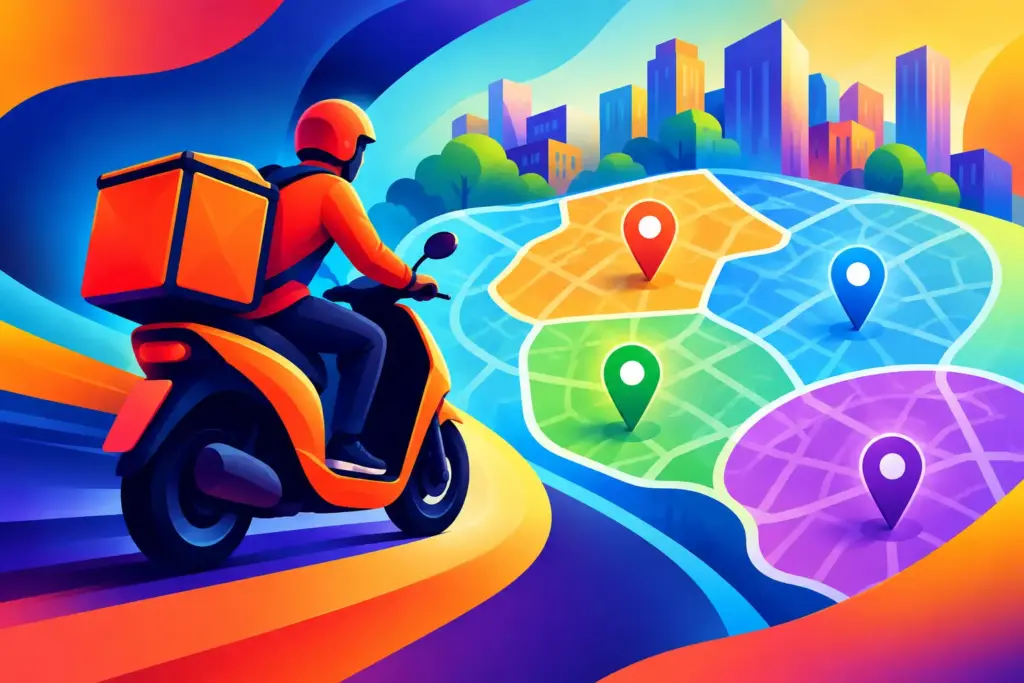
A hungry customer finds your menu, fills their basket, then discovers you do not deliver to their postcode. That does not always mean you need a bigger delivery area. It may mean you need to learn how to set delivery zones that bring in the right orders, at the right price, without sending your drivers on a costly cross-town expedition for one portion of chips.
Your delivery zone is a profit decision, not just a map setting. Set it too tightly and you turn away nearby customers who could become regulars. Set it too wide and late food, rising fuel costs and overwhelmed drivers can eat into every sale. The goal is simple: deliver a great experience where you can reliably make money.
How to set delivery zones for profitable orders
Start with your kitchen, not your competitors. A pizza shop with two drivers, a busy Friday night and a 35-minute average cooking time needs a different delivery setup from a café sending sandwiches across a compact town centre.
Ask one practical question: how far can an order travel and still arrive as you intended it? Think about food quality, driver availability, traffic, parking, weather and the time it takes to get back to the restaurant. If a driver needs 15 minutes to reach an address and 15 minutes to return, that single delivery can take them out of circulation for half an hour.
For many takeaways, a smaller reliable zone beats a giant one that creates complaints. Customers will forgive a limited delivery range more easily than cold food and an hour-long wait. Protect the experience first. Repeat orders follow.
Choose postcodes, distance or a map boundary
There are three common ways to build delivery zones, and the best one depends on how your local area is laid out.
Postcode-based zones work well when your delivery area is easy to define by postcode districts or sectors. They are clear for staff and customers, especially in towns where the boundary between neighbourhoods is obvious. The downside is that a postcode can cover streets that are much closer or farther away than they look.
A distance radius is useful for restaurants in dense areas. You might deliver within two miles for free, then charge more for addresses between two and four miles. This is quick to understand, but straight-line distance does not account for river crossings, one-way systems, railway lines or slow roads.
Map-based boundaries give you the most control. You can draw around the streets you genuinely want to serve and avoid awkward areas that take too long to reach. If your restaurant sits near a motorway, industrial estate or patchy rural roads, a custom boundary can save a lot of grief.
Do not choose a method because it sounds clever. Choose the one your team can explain, manage and fulfil during the busiest part of service.
Build zones around delivery time, not optimism
Use real journey times when setting your boundaries. Open a mapping tool during lunch and evening peak periods, then check how long it takes to travel from your premises to the edge of each proposed zone. Add time for finding the address, parking, handing over the order and getting back on the road.
Now combine that with kitchen time. If your average order takes 20 minutes to prepare and a round trip at the edge of the zone takes 30 minutes, your quoted delivery time needs to be realistic. Promising 30 minutes when the operation needs 50 is a quick route to refund requests and bad reviews.
A useful starting point is to divide your delivery area into three rings:
- Core zone: Your closest streets. Offer your best delivery deal here, such as free delivery above a sensible minimum spend.
- Standard zone: A profitable middle area with a modest delivery charge and a clear estimated delivery time.
- Extended zone: The furthest addresses you can serve without damaging quality. Use a higher fee, higher minimum spend or limited availability at peak times.
These are not fixed rules. A rural takeaway may need larger zones and higher minimums because every delivery takes longer. A city centre restaurant may keep zones tight but process more orders per hour. Let your numbers make the decision.
Set delivery fees that cover the real cost
Free delivery can be a powerful offer, but it is not free for you. Every delivery has a cost: driver pay, vehicle expenses, insurance, fuel, packaging, payment processing and the value of the driver’s time.
Work out the average cost of a delivery, then decide how much of it the customer should cover. You may absorb the cost in your core zone to encourage larger baskets and repeat business. Further out, a delivery fee is fair. Customers generally understand that a longer journey costs more, especially if you show the charge before checkout.
Minimum order values matter just as much. A £9 order delivered six miles away can look like revenue, but it may leave almost nothing after food cost and delivery expense. Set a minimum that protects margin in each zone. Your closest zone can have a lower threshold; your furthest zone should earn its place on the map.
Avoid hiding fees until the last step. Surprise charges create abandoned baskets. Be upfront, keep the wording simple and make the value obvious: direct ordering, accurate delivery times and food that arrives properly hot.
Plan for busy periods before they plan for you
The zone that works at 4pm may not work at 7.30pm on a rainy Saturday. Delivery settings should support how your restaurant actually operates, not force your team to keep accepting orders they cannot fulfil.
If you have limited drivers, consider pausing the extended zone during peak periods. You can still serve your nearby regulars quickly while the kitchen is flat out. Alternatively, increase the delivery time estimate or minimum spend for outer areas when demand jumps.
This is not turning business away for the sake of it. It is protecting the orders you do take. A busy kitchen with controlled delivery zones can keep customers coming back. A kitchen accepting every possible order can end up with cold meals, stressed staff and a phone ringing off the hook.
Give your team a simple rule for exceptions. Perhaps staff can approve an address just outside the boundary for a loyal customer if a driver is already heading that way. But do not make exceptions the standard process. If the same area keeps requesting delivery, either add it properly with the right fee or leave it out.
Test your zones after launch
Your first delivery map is a starting point, not a permanent verdict. Review it after a few weeks of trading. Look at where orders come from, average basket value, delivery times, late-order complaints and how often drivers return with delays.
You may find that a small cluster just outside your original boundary spends well and is easy to reach. Add it. You may also discover that an apparently nearby estate causes delays every time because of access issues and traffic. Adjust the map or change its fee.
Pay attention to rejected carts and customer questions too. If people regularly ask whether you deliver to a particular neighbourhood, there may be demand worth assessing. If the answer is no, be clear and polite. A firm, honest boundary is better than a vague promise your operation cannot keep.
With Ordering Website, operators can configure delivery areas as part of a branded direct-ordering setup, so customers see whether you deliver to them before the order becomes a kitchen problem. That means more control over your area, your fees and your customer relationship, without handing a commission to a marketplace for every order.
Keep customers informed at checkout
A delivery zone only works when customers understand it. Show whether an address is eligible as early as possible, along with the delivery fee, minimum order and expected time. The fewer surprises at checkout, the fewer abandoned orders and frustrated calls.
Use plain wording. “We deliver within three miles” is helpful. “Delivery available to selected areas” is not. If you use postcode zones, make sure the system checks addresses accurately. If you offer collection outside your delivery range, say so clearly. A customer who cannot get delivery may still happily collect if ordering is quick and the food is worth the trip.
Also make your delivery times honest. It is better to quote 50 minutes and arrive in 40 than promise 30 and turn up late. Reliability is marketing. Every accurate delivery makes the next direct order easier to win.
Delivery zones should earn their place
Do not measure a delivery area by how large it looks on a map. Measure it by the quality of food arriving at the door, the workload on your team, the profitability of each run and the number of customers who order again next week.
Start close, price with purpose and expand when the data says the opportunity is real. Your food deserves to arrive hot, your drivers deserve a workable route, and your business deserves to keep more of every order.